Why This Comparison Actually Matters in 2026
If you’ve typed “Deel vs Remote” into Google recently, you’re not alone. These two platforms dominate every EOR shortlist in 2026 — they have the largest marketing budgets, the most G2 reviews, and the most enterprise logos in the space. For most HR teams evaluating global workforce platforms, Deel and Remote end up as the two finalists.
But here’s the thing that most comparison articles won’t tell you upfront: the wrong choice at this stage is genuinely expensive. A 30-person global team paying $599 per employee per month spends over $215,000 a year on EOR fees alone. That’s before a single salary is paid. At that scale, choosing the right platform for your specific situation isn’t a minor preference — it’s a budget decision with a five- or six-figure annual impact.
This comparison is built on verified data from G2, Capterra, vendor documentation, and independent third-party evaluations. I’m also a Deel affiliate — my referral link is at the end — but the analysis below reflects genuine research, including the areas where Remote.com genuinely outperforms Deel. Balanced means balanced.
We’ll compare both platforms across five evaluation criteria: pricing, country coverage, compliance model, contractor management, platform UX and integrations, and customer support. Each section ends with a clear winner. At the end, you’ll find a full scoring matrix and a decision framework for every use case.
Platform Overview: What Each One Actually Is
Both Deel and Remote.com launched in 2019, both are headquartered in the US, and both set out to solve the same problem: letting companies hire internationally without setting up local legal entities. In 2026, they’ve both scaled significantly — but they’ve done it with different philosophies.
Deel: The All-in-One Global Workforce OS
Deel started as a contractor payments tool and expanded aggressively through acquisitions into a full global HR suite. As of 2026, Deel reports over 35,000 customers, EOR coverage in 150+ countries, and holds a 4.8-star rating across roughly 14,000 G2 reviews, ranking #1 in the Employer of Record, Global Employment Platforms, and Multi-Country Payroll categories. The product suite spans EOR, global payroll, contractor management, a free HRIS, immigration support, equity management, IT asset management, and more.
Deel’s positioning is breadth. It’s built for companies that want a single platform to replace multiple HR and payroll vendors — one dashboard, one audit trail, one support team across all global workforce needs.
Remote.com: The Compliance-First EOR
Remote takes a more focused approach — EOR in 80+ countries, contractor payments, and global payroll — with a strong emphasis on compliance, IP protection, and a clean user experience. Remote owns its own legal entities in every country it operates in, rather than using third-party partners in some markets, which gives it tighter control over compliance.
Remote holds a 4.6-star average across G2, Capterra, and Trustpilot reviews. Its positioning is depth over breadth — fewer countries than Deel, fewer add-on products, but stronger end-to-end ownership of the compliance stack in the markets it does cover.
Criterion 1: Pricing — What You’ll Actually Pay
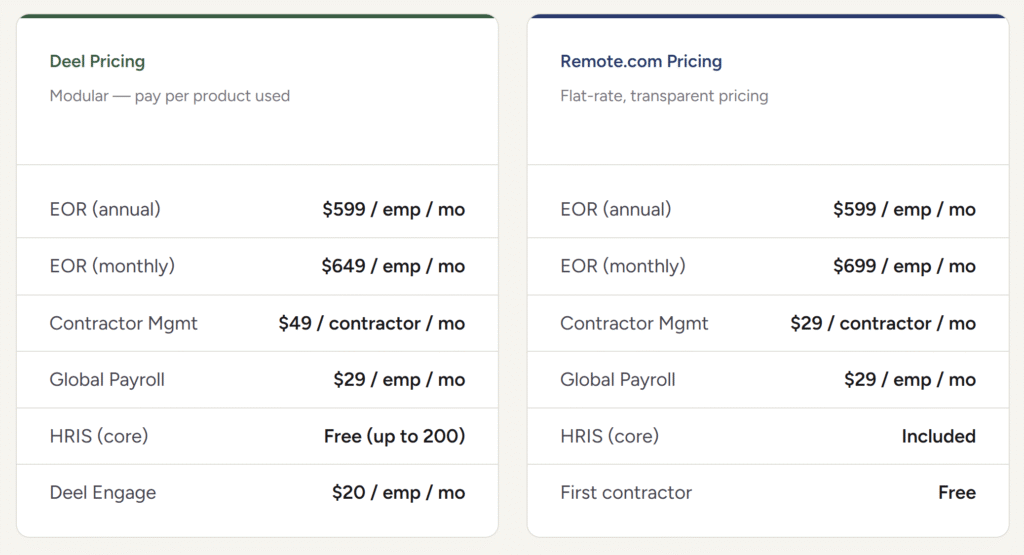
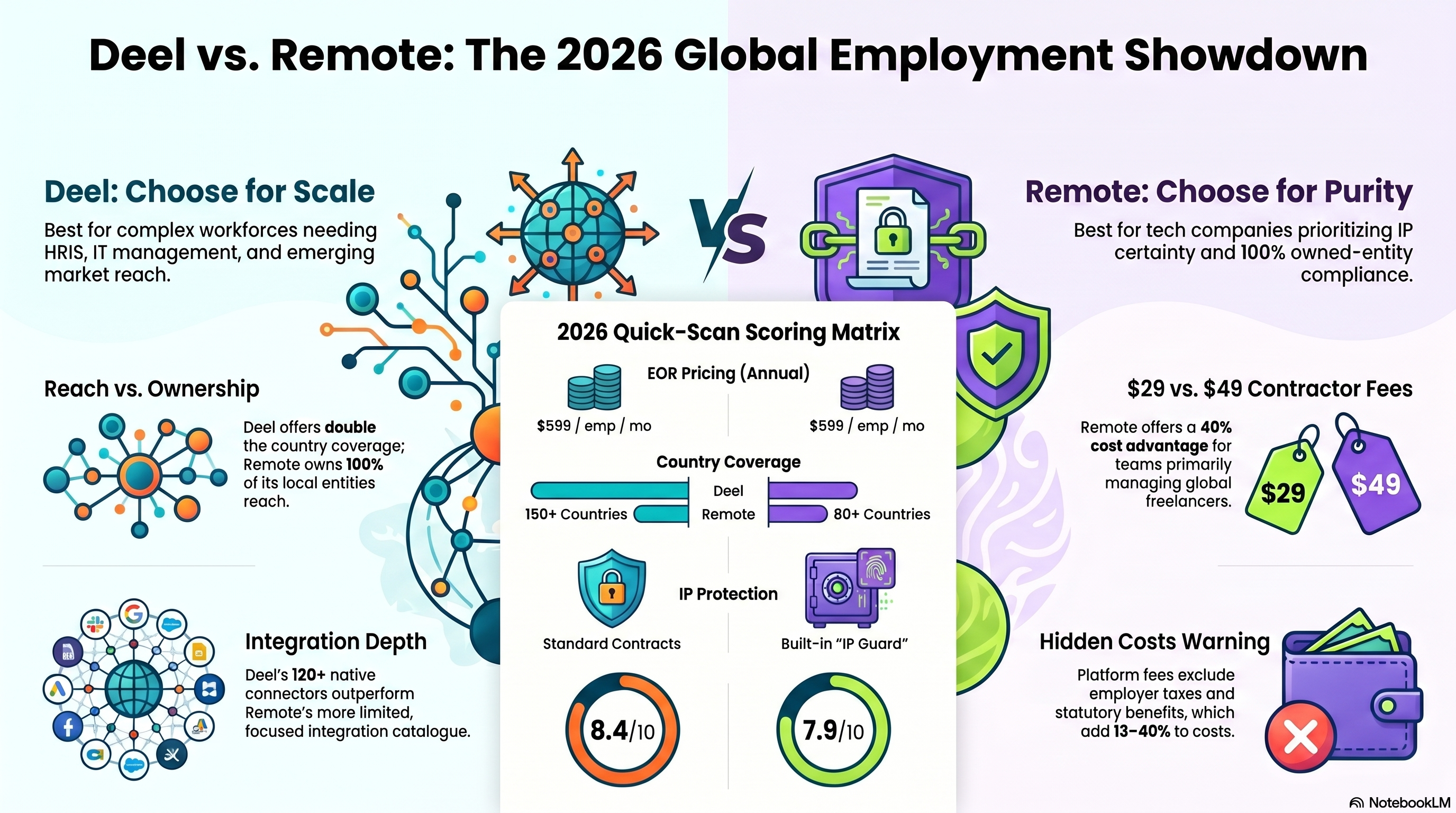
At the EOR level, EOR pricing is identical at $599 per employee per month on annual plans. The meaningful differences emerge at the contractor tier and on monthly billing. Remote is 40% cheaper for contractor management at $29 per month versus Deel’s $49. They also offer a free plan for your first contractor. For early-stage startups that primarily use contractors, this pricing advantage is meaningful and real.
However, the per-seat sticker price isn’t the complete picture for Deel. On paper, Remote is cheaper for contractor-heavy teams — if you’re paying 10 contractors, that’s $490 per month with Deel versus $290 per month with Remote. But Deel includes significantly more in that price: more integrations, IT management, immigration support, and broader country coverage.
🏆 Winner: Remote.com (Contractor Pricing)
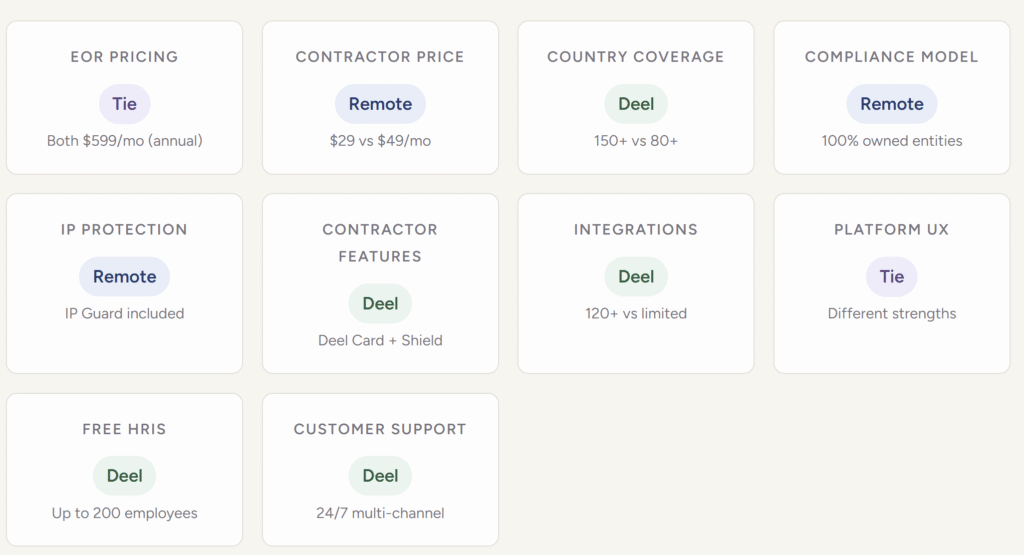
Remote wins on contractor management pricing — $29 vs $49 per month is a genuine 40% cost advantage. For EOR, both platforms are identically priced at the annual rate. Deel wins on monthly EOR ($649 vs $699), but the contractor pricing gap favours Remote for contractor-heavy teams.
Criterion 2: Country Coverage — Breadth vs. Depth
This is one of the starkest differences between the two platforms, and it matters enormously depending on where your team is located.
Deel covers EOR in 150+ countries, which is roughly double Remote’s coverage. If you’re hiring in Southeast Asia, Africa, or parts of Latin America, Deel is more likely to have the country you need. This breadth comes from Deel’s hybrid model — a mix of wholly-owned entities and vetted local partners in markets where full entity ownership isn’t yet established.
Remote takes a more focused approach — EOR in 80+ countries — but owns its own legal entities in every country it operates in, rather than relying on third-party partners. This gives it tighter control over compliance and a more consistent employee experience.
The 80+ vs 150+ country gap is worth unpacking. For most teams, 80 countries covers the vast majority of global hiring scenarios — all major markets in Europe, North America, Asia-Pacific, and Latin America are included. The difference matters primarily for companies expanding into frontier markets: Nigeria, Ghana, Vietnam, Pakistan, or other emerging-economy hiring hubs where Remote may not yet have a presence.
“The country you need to hire in is the most important variable in this decision. If Remote covers it, their owned-entity model is compelling. If they don’t, Deel is often the only tier-one option.”
— Independent EOR Analyst, PayrollRated, March 2026
🏆 Winner: Deel (Country Coverage)
Deel’s 150+ country coverage is approximately double Remote’s 80+. For teams hiring in emerging markets or across a wide range of geographies, Deel’s reach is a genuine and significant advantage. Remote wins on depth of owned-entity compliance within the countries it does cover.
Criterion 3: Compliance & Legal Model — The Critical Difference
This is where the philosophical difference between Deel and Remote becomes most pronounced — and where the right choice genuinely depends on your risk tolerance and the nature of your workforce.
Remote’s Owned-Entity Model
Remote owns all of its local legal entities — no third-party partners. This gives them tighter control over compliance and a more consistent employee experience. They also include IP protection by default in every EOR agreement, which is a genuine advantage for companies building proprietary technology with distributed teams.
Remote’s IP Guard feature transfers intellectual property rights directly from the local entity to you at no extra cost, which matters for software companies with distributed engineering teams. For a tech company with distributed engineers contributing to a proprietary codebase, this is not a minor feature — it’s a legal safeguard with real enterprise value.
Remote emphasizes uncapped indemnity, proactive classification guidance, and IP protection through Remote IP Guard — designed for companies that want strong legal safeguards and confidence when hiring contractors in unfamiliar or high-risk jurisdictions.
Deel’s Hybrid Compliance Approach
Deel operates through a combination of wholly-owned entities (approximately 250 globally) and vetted local partners in markets where full entity ownership isn’t feasible. This enables its 150+ country reach but means compliance delivery is not uniformly owned end-to-end across all markets.
In its core markets, Deel’s compliance infrastructure is mature — automated tax calculations, statutory benefits management, misclassification protection through Deel Shield, and AI-powered compliance assistants that flag payroll anomalies before they reach employees. For most standard global hiring scenarios, this is more than sufficient.
Deel also includes contractor misclassification protection (Deel Shield) and localized contract generation in its contractor management product, which is a meaningful compliance layer for HR teams managing large freelancer pools.
🏆 Winner: Remote.com (Compliance Model)
Remote’s 100% owned-entity model gives it stronger end-to-end compliance control, and Remote IP Guard is a standout feature with genuine legal value for tech companies. Deel’s compliance infrastructure is excellent for most use cases, but Remote’s model provides a higher degree of legal certainty.
Criterion 4: Contractor Management — Experience on Both Sides
Both platforms offer contractor management as a core product, but they differ meaningfully in pricing, features, and the experience delivered to contractors themselves.
Deel Contractor Management
At $49 per contractor per month, Deel’s contractor product bundles localized contract generation, multi-currency payments, Deel Shield misclassification protection, e-invoicing, and the Deel Card. The onboarding flow is genuinely fast — Deel auto-generates a legally compliant contract specific to the contractor’s country in seconds. The contractor portal is well-designed, with clear payment status visibility and multiple withdrawal options including crypto and the Deel Card for instant access to funds.
Remote Contractor Management
Remote’s contractor management features include locally compliant contract templates, e-signature, time tracking, automated invoicing and payments in local currencies, and built-in compliance rules like IP protection and misclassification risk alerts. At $29 per month, it’s meaningfully cheaper than Deel — and for teams that primarily need basic contractor onboarding and payment in well-established markets, it delivers the essentials reliably.
Remote also offers a Contractor of Record (COR) service, where Remote can legally engage contractors on your behalf, assuming compliance liability and offering uncapped indemnification and IP protection.
🏆 Winner: Deel (Contractor Features)
Deel’s contractor product is more feature-rich — more payment options, Deel Shield, the Deel Card, and a stronger contractor-side experience. Remote wins on pure price ($29 vs $49). Choose based on what matters more for your team: cost efficiency or feature depth.
Criterion 5: Platform UX & Integrations
A platform you actually use effectively is worth more than one with more features you can’t navigate. Both platforms have invested heavily in UX — but they feel different in practice.
Deel’s Interface
G2 reviewers highlight Deel’s intuitive UI, automated onboarding, and broad global coverage, making complex hiring and compliance far easier to centralize. The payroll dashboard provides a central view of total spending, payment cycles, and pending approvals. The self-service design — where workers can update their own payment details and submit invoices without raising HR tickets — reduces admin burden significantly.
Deel’s integration ecosystem is one of its strongest differentiators. It connects natively with over 120 tools including Okta, Slack, NetSuite, JumpCloud, Workday, and QuickBooks — enabling HR data to flow into existing tech stacks without manual reconciliation. For enterprise buyers with established systems, this is a material advantage.
Remote’s Interface
If you’re only using EOR and contractors, Remote’s interface feels lighter and easier to navigate on day one. There’s less to learn because there’s less product. For teams that don’t need IT management or 110+ integrations, this simplicity is a feature, not a limitation.
G2 reviewers emphasize Remote’s user-friendly interface, clear cost transparency, and strong compliance control across multiple countries. Strengths include organized onboarding, reliable payroll, and intuitive employee self-service.
Remote’s integration catalogue is more limited than Deel’s — it covers the major HRIS and accounting platforms but doesn’t match Deel’s breadth of 120+ native connectors. For teams already using a complex tech stack, this can create friction.
🏆 Winner: Deel (Integrations & Scale)
Deel wins on integrations depth and overall platform scale. Remote wins on simplicity for focused EOR use cases. If your team needs one platform to connect with many others, Deel’s 120+ integration ecosystem is a meaningful advantage.
Criterion 6: Customer Support — The Honest Picture
This is the area where both platforms have the most room to improve — and where verified user feedback is most consistent across both G2 and Trustpilot.
You can reach Deel’s customer support 24/7 via live chat, email, and even phone. Analyzing over 50 user reviews on G2 around customer support, they were generally positive, appreciating how knowledgeable and responsive the support staff is — though most of Deel’s reviews are left by individual contractors who use it to receive payments, so enterprise HR team experiences may vary.
For Remote, support responsiveness is the most consistent complaint across both G2 and Trustpilot. For time-sensitive HR issues, ticket-based response times create real friction. Reviewers note that when a payroll error or compliance question needs resolution quickly, waiting 24 to 48 hours for a reply translates directly into an operational problem. The pattern surfaces more frequently as employee count grows and issues multiply.
Neither platform has fully cracked this problem. Neither platform has solved the support challenge, so expect delays on complex cases regardless of which you choose. The key practical guidance: for either platform, establish a named account manager relationship early, and don’t rely on ticket-based support for time-sensitive compliance or payroll issues.
🏆 Narrow Win: Deel (Support Availability)
Deel’s 24/7 multi-channel support (live chat, email, phone) gives it an edge over Remote’s more ticket-driven model. In practice, both platforms have support limitations for complex enterprise issues — this is an industry-wide challenge, not unique to either platform.
Full Scoring Matrix: Quick-Scan Comparison
Who Should Choose Which — The Decision Framework
Final Verdict: 8.4 vs 7.9
Both Deel and Remote.com are tier-one EOR platforms — genuinely well-built, well-funded, and capable of supporting global hiring at scale. The choice between them is not about which is “better” in the abstract; it’s about which fits your specific situation.
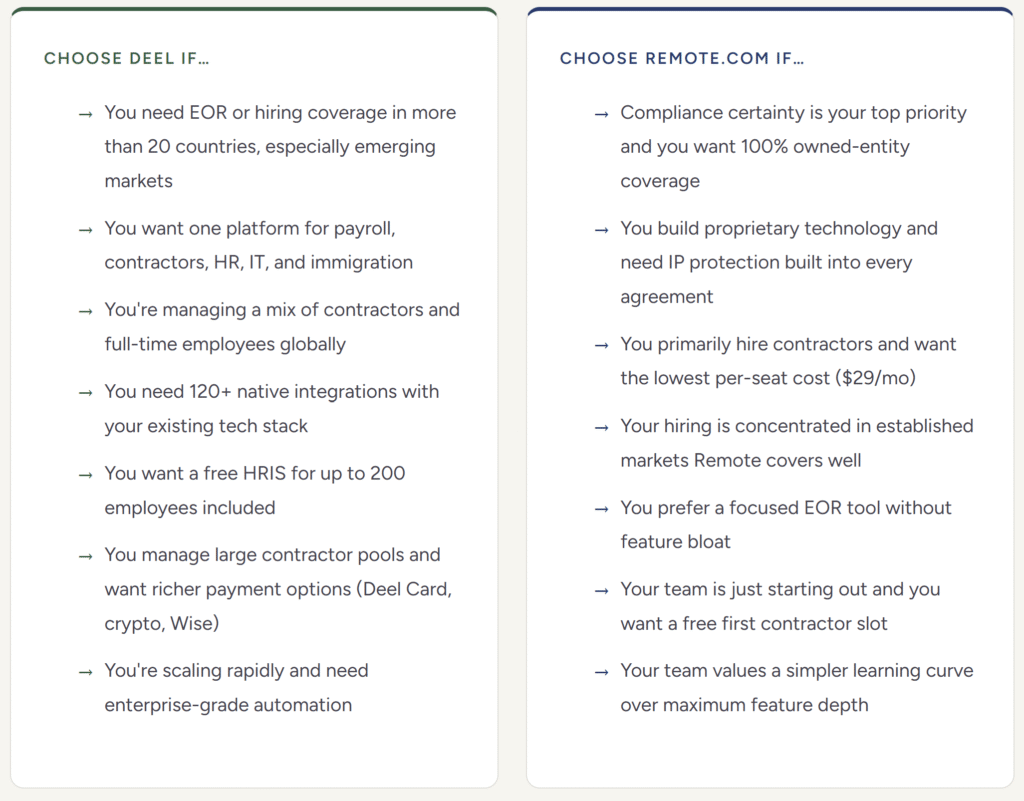
Deel earns the edge as the overall platform — broader country coverage, a richer feature set across payroll, contractor management, HRIS, and integrations, a stronger G2 rating, and 24/7 multi-channel support. For teams building complex, multi-country workforces who want one consolidated platform, Deel is the stronger default in 2026.
Remote.com earns the edge on compliance purity and contractor cost. If your top priority is legal certainty — particularly around IP ownership and entity compliance — Remote’s 100% owned-entity model and IP Guard are genuine competitive advantages. And at $29 per contractor per month, it’s the more cost-effective choice for contractor-heavy teams.
Neither platform has solved the customer support challenge at scale. For both, building a named account manager relationship early is essential. And for both, always verify exact country coverage and get a full cost simulation before committing.
Ready to Try Deel?
Access the free HRIS tier immediately — no credit card required — and book a demo of global payroll and contractor management.