Managing a distributed workforce has become significantly more complex over the last few years. Hiring contractors in multiple countries, running international payroll, staying compliant with labor laws, and managing HR processes across borders can quickly overwhelm growing companies.
This is where Deel positions itself — as an all-in-one workforce platform for payroll, contractor management, HR operations, and compliance.
After reviewing Deel’s core products, analyzing user feedback, and evaluating how the platform performs for remote-first businesses, here’s an honest breakdown of what Deel does exceptionally well, where it struggles, and whether it deserves a place in your tech stack.
What is Deel?
Founded in 2019, Deel started with a straightforward mission:
Enable companies to hire anyone, anywhere — without dealing with global payroll and compliance headaches.
Today, Deel has evolved into one of the largest global workforce management platforms, supporting:
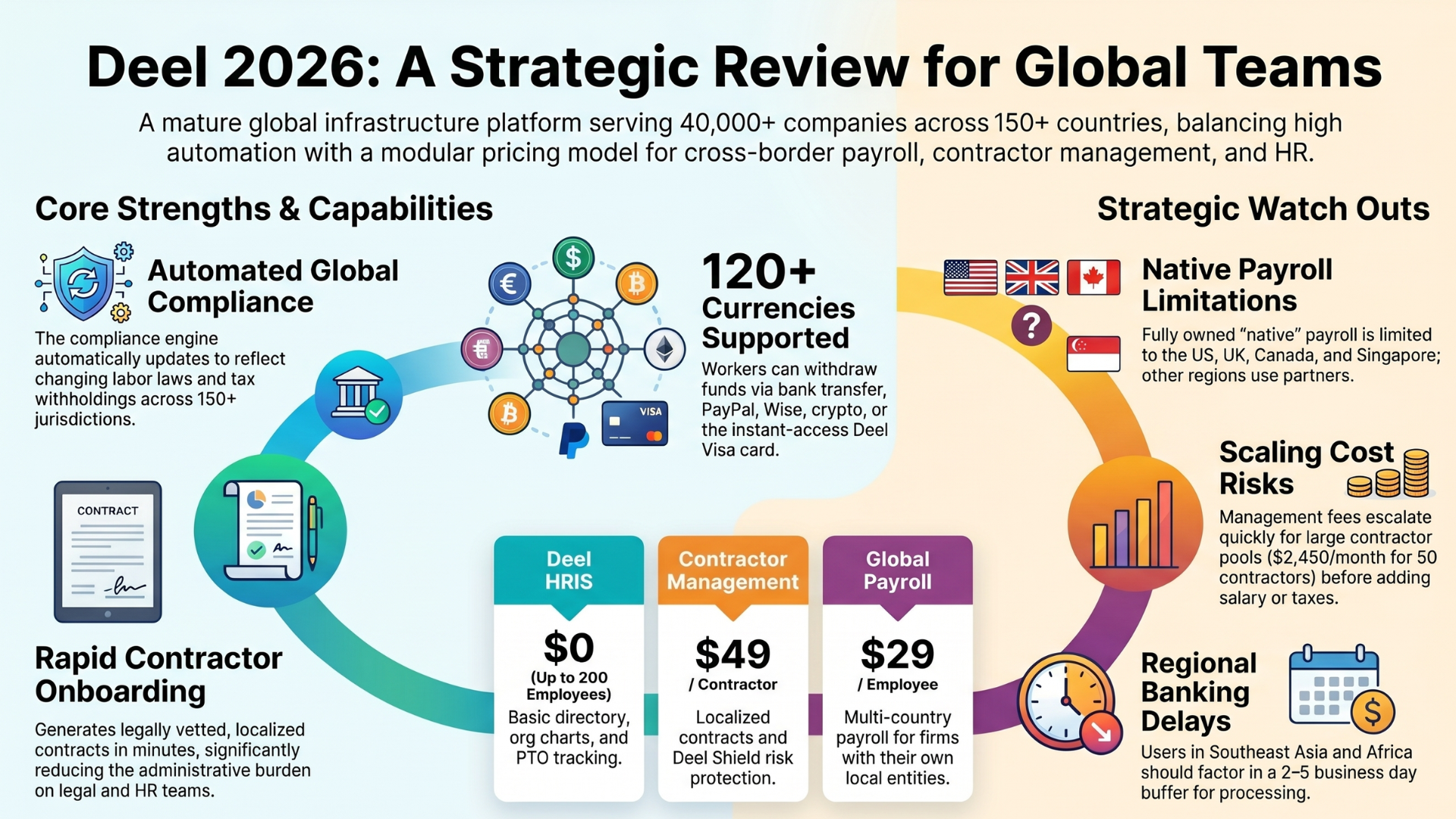
- 40,000+ companies worldwide
- 1.5+ million workers paid globally
- Operations across 150+ countries
- Support for 120+ currencies
- Extensive payroll, contractor, and HR tools
What separates Deel from many competitors is that it isn’t simply a payroll platform. It combines:
- Global payroll infrastructure
- Contractor management
- HRIS functionality
- Compliance monitoring
- Workforce analytics
- IT management tools
- Automation workflows
That breadth is both its biggest advantage and biggest challenge.
Deel’s Product Ecosystem at a Glance
| Product | Rating | Best For |
|---|---|---|
| Global Payroll | 8.7/10 | International payroll management |
| Contractor Management | 8.9/10 | Distributed contractor teams |
| Deel HR / HRIS | 7.8/10 | Growing global companies |
| Value for Money | 7.5/10 | Mid-sized to large distributed teams |
Global Payroll: Deel’s Strongest Offering
Global payroll remains Deel’s most mature product.
Companies can automate payroll calculations, tax handling, and payments while supporting workers across dozens of countries from a single dashboard.
What Works Well
Centralized Payroll Management
Instead of managing multiple vendors, accountants, or local payroll providers, Deel centralizes:
- Payroll approvals
- Tax calculations
- Salary distribution
- Currency conversions
- Benefits administration
- Compliance monitoring
For companies operating internationally, this significantly reduces operational overhead.
Multi-Currency Support
Employees and contractors can receive payments through:
- Local bank transfers
- Wise
- PayPal
- Deel Card
- Cryptocurrency options
- Alternative payout methods
The transparent FX pricing is also appreciated by finance teams that want visibility into exchange costs.
Compliance Automation
Global compliance is one of the largest hidden costs of expansion.
Deel automates:
- Tax withholding calculations
- Required payroll filings
- Statutory benefits handling
- Local labor law updates
- Country-specific payroll requirements
For businesses hiring internationally, this reduces substantial legal risk.
Limitations of Global Payroll
Despite its strengths, there are tradeoffs.
Native Payroll Coverage Is Limited
Deel’s fully owned payroll infrastructure primarily covers:
- US
- UK
- Canada
- Singapore
In many countries, Deel works through local partners rather than fully owned entities.
Regional Payment Delays
Companies operating in:
- Southeast Asia
- Certain African countries
- Regions with strict banking controls
may experience slower payment timelines.
Reporting Limitations
Finance teams requiring:
- Advanced workforce forecasting
- Deep reporting segmentation
- Custom financial analytics
may find Deel’s reporting functionality restrictive.
Contractor Management: Where Deel Truly Excels
For many companies, contractor management alone justifies Deel’s cost.
Fast Global Onboarding
Contractor onboarding includes:
- Country-specific contracts
- Digital signatures
- Automated document collection
- Local compliance checks
- Tax documentation
New contractors can often be onboarded within minutes.
Better Contractor Experience
Contractor experience matters more than most platforms recognize.
Deel provides contractors:
- Self-service payment portals
- Invoice generation
- Payment tracking
- Multiple withdrawal methods
- Currency flexibility
Less friction means fewer support tickets and happier contractors.
Deel Shield: Risk Protection
Misclassification risk is increasing globally.
Deel Shield helps identify:
- Contractor relationships resembling employment
- Local compliance risks
- Potential legal exposure
This feature alone can save companies significant costs.
The Pricing Problem
At:
$49 per contractor/month
costs increase rapidly.
Examples:
- 10 contractors = $490/month
- 50 contractors = $2,450/month
- 100 contractors = $4,900/month
For large contractor networks, pricing becomes a serious evaluation point.
Deel HR / HRIS: Useful, But Not Deep
Deel’s HR module is designed primarily to support payroll and workforce operations rather than replace enterprise HR systems.
What You Get for Free
The free tier supports up to 200 employees and includes:
- Employee directory
- Org charts
- PTO tracking
- Document storage
- Employee records
- Basic onboarding workflows
This is one of Deel’s strongest value propositions.
Additional HR Features
Paid modules unlock:
- Performance reviews
- Goal tracking
- Learning systems
- Compensation workflows
- Advanced workflows
HRIS Weaknesses
Where the platform feels limited:
- Basic workforce analytics
- Limited compensation management
- Mobile experience lacks parity with desktop
- Weak performance management depth
Organizations requiring advanced HR functionality may still need specialist HR software.
Pricing Breakdown: What Deel Actually Costs
Pricing is modular.
That flexibility is useful — but also creates complexity.
| Product | Starting Price |
| Deel HRIS | Free (up to 200 employees) |
| Contractor Management | $49 per contractor/month |
| Global Payroll | $29 per employee/month |
| Deel Engage | $20 per employee/month |
| US PEO | $95 per employee/month |
| Deel IT | Starting at $99/month |
| EOR Services | Starting around $599 per employee/month |
Pricing Reality
Published pricing rarely reflects total cost.
Additional expenses often include:
- Employer taxes
- Benefits
- Currency conversion fees
- Country-specific compliance costs
- Add-on modules
Companies should model total workforce costs before implementation.
Pros and Cons
Pros
What Deel Does Well
- Unified platform for payroll, contractors, and HR
- Strong contractor onboarding workflows
- Excellent compliance automation
- Transparent currency conversions
- Free HRIS offering
- Large integration ecosystem
- Strong international coverage
- Good worker experience
Cons
Where Deel Falls Short
- Expensive at scale
- Limited native payroll markets
- Analytics remain basic
- Mobile experience is underdeveloped
- Setup complexity for smaller businesses
- Advanced features require upgrades
- Weekend support responsiveness varies
Who Should Use Deel?
Great Fit For:
Remote-First Companies
Teams managing workers across multiple countries benefit most.
Scaling Startups
International hiring becomes significantly easier.
HR Teams Consolidating Tools
Replacing multiple vendors can create operational efficiencies.
Not Ideal For:
Small Domestic Businesses
If your workforce operates within one country, Deel may be excessive.
Companies Needing Deep HR Capabilities
Dedicated HR platforms still outperform Deel in specialized HR workflows.
Final Verdict: Is Deel Worth It in 2026?
Deel remains one of the strongest platforms for managing international teams.
Its biggest strengths remain:
- Global payroll automation
- Contractor management
- Compliance infrastructure
- Strong onboarding workflows
- Consolidated workforce operations
Its biggest drawbacks remain:
- Pricing at scale
- HR feature depth
- Native payroll limitations
Final Score: 8.4 / 10
Best for companies managing complex international teams.
If your company operates across borders and spends significant time handling payroll, compliance, and contractor administration manually, Deel can create immediate operational value.
If your team is local, small, or only needs basic payroll functionality, simpler alternatives may provide better ROI.