In the high-stakes world of real estate and property management, the greatest threat to your ROI isn’t the market—it is operational friction leading to lead decay. When inquiries are scattered across Facebook messages, WhatsApp chats, and website forms, the cost of inaction grows by the minute. If a lead isn’t triaged instantly, it doesn’t just sit there; it cools, eventually disappearing into the gap between fragmented tools and manual spreadsheets.
For property professionals, the daily struggle of manually assigning leads and chasing agents for updates is a massive drain on resources. This lack of a unified system creates a “silo effect” where data exists but remains unactionable. You aren’t just losing leads; you are losing the high-level visibility required to scale your empire.
The solution is a centralized, automated engine built on monday.com and Make. By integrating these platforms, property leaders can transform a disjointed funnel into a sophisticated workflow that ensures every inquiry is captured, categorized, and closed with military precision.
The “Everything, Everywhere” Lead Funnel
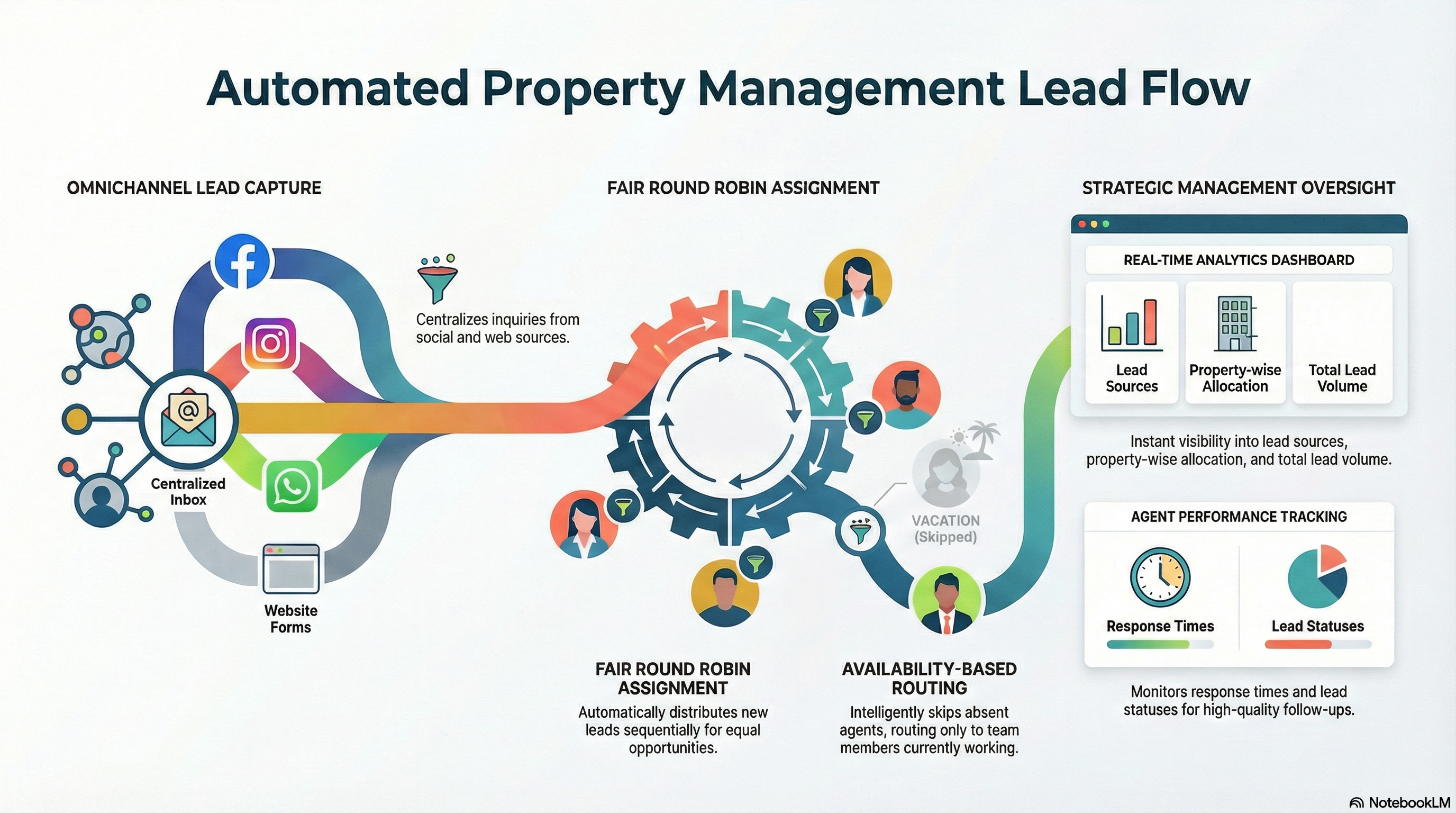
The foundation of strategic lead management is the “Main Board”—a single source of truth where every prospect lands. Whether an inquiry stems from a Facebook or Instagram ad, a website blog post, a direct call, or a WhatsApp message, the system captures the data instantly. This eliminates the risk of leads dying in a forgotten notification or a personal inbox.
A critical component of this stage is data hygiene. In high-volume channels like WhatsApp, the system uses automated logic to detect duplicate numbers. If a contact already exists, the system flags it rather than cluttering your board with “noise,” ensuring your sales team focuses only on fresh opportunities.
“Facebook, Instagram ad, your website, your blog… WhatsApp… these are all the leads that are going to land here.”
Intelligence-Driven Distribution (Beyond Simple Round-Robin)
Once a lead is captured, it must move. While many firms rely on a basic round-robin assignment, a sophisticated PropTech workflow incorporates “Working Status” logic. The system checks an Employee Status Board before assigning a lead, identifying if an agent is on “Vacation Mode” or currently unavailable.
If the next agent in the rotation is out of the office, the automation intelligently skips them and assigns the prospect to the next available team member. This prevents “lead stagnation,” ensuring that a hot prospect is never left waiting because of an agent’s OOO status. This maintains fairness in the team while prioritizing the speed of response.
The Power of the Agent Workspace and “Transfer Logic”
To maximize productivity, agents should never have to navigate the master database. Instead, the system uses a hierarchical structure where data is mirrored from the Main Board to individual Agent Boards. As soon as a lead is assigned, the agent receives a private record in their own workspace, reducing cognitive load and allowing them to focus on their specific pipeline.
However, not every lead is a perfect match. The source context highlights a vital strategic feature: Transfer Lead Logic. If an agent determines a lead isn’t the “right fit” or falls outside their specific domain, they can trigger a transfer automation.
Instead of the lead being lost or manually re-emailed, it is re-routed to the “Transfer Leads” board and automatically assigned to a better-suited agent. This ensures that every lead stays within the ecosystem until it is either closed or disqualified.
Transparency Through the “Hierarchy of Stats”
For leadership, the ultimate value of automation is the ability to oversee operations without micro-management. A centralized dashboard provides a Hierarchy of Stats, allowing the upper hierarchy to view the health of the business at a glance.
The system categorizes inquiries by Lead Type, distinguishing between Brokers, Investors, and End Users. This allows you to see not just how many leads you have, but the quality and intent of your audience.
“They don’t have to jump into the data to see that which lead, which agent is working… only the stats of it.”
Specific dashboard widgets track property-wise allocation, “last week’s” performance, and source performance (comparing Ad spend vs. Walk-ins vs. Website forms). This real-time data allows you to pivot marketing spend toward the channels that actually convert.
Automation as an Accountability Tool
A performance-based culture requires objective data. This system acts as an accountability engine by tracking the exact moment an agent takes action after a lead is assigned. By monitoring “response status” and timestamps, management can see exactly how quickly the sales team is engaging with new prospects.
This data-driven approach allows you to identify bottlenecks in the sales process and reward high-performers based on hard metrics rather than subjective check-ins. When you can see the response time for every single salesperson, accountability becomes a built-in feature of your workflow, not an afterthought.
Final Thought: Scaling Your Property Empire with Systems
Scaling a property management business is impossible if your foundation is “leaky.” Every minute a lead sits unassigned or uncontacted, your conversion probability plummets. By moving away from manual triaging and adopting an automated distribution ecosystem, you reclaim your time and protect your margins.
Ask yourself: where is the friction in your current funnel? If you cannot see your lead-to-response time in real-time, you are likely losing revenue to more agile competitors.