Why the Future of Roofing Starts with an AI That Never Sleeps
The Midnight Roofing Crisis
For a roofing enterprise, the sound of a midnight storm in a city like Tucson is both a signal of surging demand and a high-stakes test of operational resilience. When a homeowner discovers a roof leak in their bathroom at 2:00 AM, the “lead lifecycle” is measured in minutes, not hours. If your office line goes to a generic voicemail or a lackluster third-party answering service, that homeowner simply moves to the next search result. In this industry, latency is the enemy of conversion. To bridge this gap, modern firms are deploying AI-Powered Virtual Receptionists—a strategic layer of automation that ensures immediate, high-fidelity engagement when the stakes are highest.
The “Senior Representative” Standard, 24/7
In the roofing sector, the initial contact must project immediate authority to halt the customer’s search for a competitor. A generic answering service often fails because it lacks industry-specific context, leading to a breakdown in trust. By contrast, a sophisticated AI agent functions as a platform-agnostic “Senior Representative.”
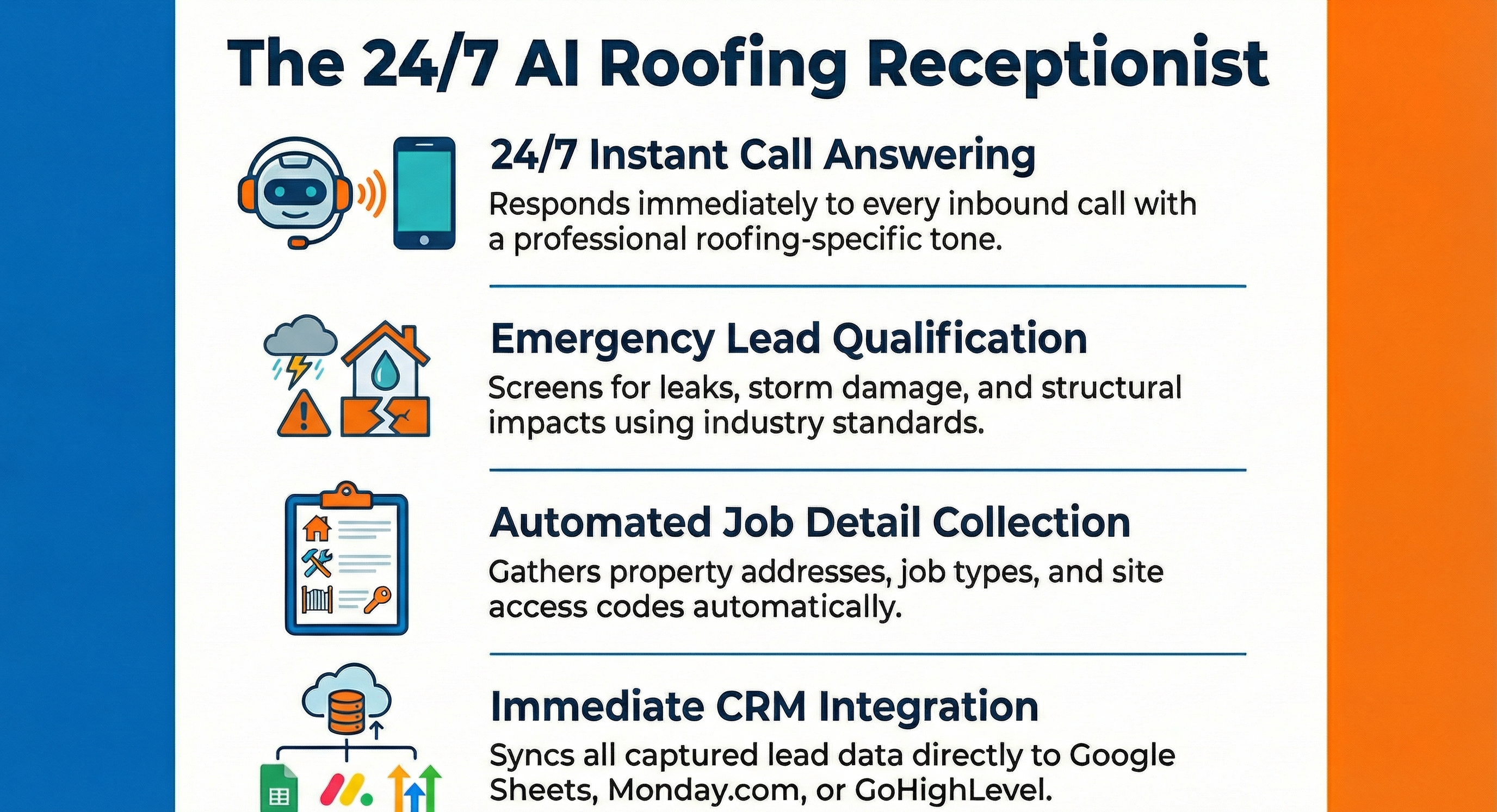
“It answers every inbound call instantly, 24×7, with a tone and the control of senior roofing office representative.”
From a strategic standpoint, this isn’t just about answering the phone; it’s about maintaining a high conversion rate through perceived competence. When a caller feels they are speaking with a professional who understands the nuances of roofing, the psychological need to “keep shopping” evaporates. This AI doesn’t just take messages—it exerts control over the interaction, establishing a professional baseline that no human-staffed call center can match for cost-efficiency or consistency.
Logic-Based Triage via Industry Standards
Effective business process management requires more than just gathering names; it requires intelligent categorization. The system utilizes logic-based triage to qualify calls against established industry emergency standards: water intrusion, structural impact, and storm damage.
By identifying these variables in real-time, the AI replaces the manual “sifting” process that traditionally plagues office managers every morning. For instance, if the AI detects a high-priority incident like active water intrusion, it can immediately trigger a “TARP team mobilization” protocol. This ensures that your most critical resources are deployed via an automated hierarchy of needs, drastically reducing the time between the initial distress call and the onsite solution.
Structured Data Acquisition and the Logical Dependency Tree
The transition from a phone conversation to a CRM entry is where most roofing leads lose their integrity. To solve this, the AI follows a “supervised order” of operations—a logical dependency tree that ensures clean, structured data acquisition. The system systematically captures:
- Full name and contact number
- Property address
- Property type (Single-family, townhome, apartment, or commercial)
- Duration of the issue
- Site-specific variables (e.g., presence of pets or gate codes)
Crucially, the system is designed with a “non-breaking” flexibility. If a caller is hesitant to provide a gate code or specific sensitive information, they can opt-out of that specific prompt without crashing the automation sequence (Source 3:37). This ensures a friction-less customer experience while still capturing the 90% of data required to initiate a service ticket.
The Power of the “Accuracy Loop”
One of the most significant drain on a roofing company’s EBITDA is the “wasted truck roll” caused by incorrect addresses or contact details. Human error during a frantic emergency call is common, but the AI architecture includes a built-in “Accuracy Loop.” Even when faced with complex or mumbled inputs—such as a caller providing a confusing address sequence like “8-1-2-3 Main Street”—the AI processes the data, corrects the formatting, and repeats a comprehensive summary back to the caller for verification.
This confirmation step—verifying the phone number, address, and the specific nature of the problem (e.g., “roof leak in the bathroom”)—ensures that the information reaching your field supervisors is 100% accurate. This high-integrity data flow eliminates logistical redundancy and reinforces the professional image of the brand.
Platform-Agnostic Deployment
A primary concern for any Business Process Strategist is interoperability. This AI solution is “headless,” meaning it integrates seamlessly into your existing tech stack without requiring a total overhaul of your current systems. Whether you utilize Google Sheets, Monday.com, Go High Level, or a custom enterprise CRM, the AI acts as a high-speed data entry engine. It feeds structured lead data directly into your management systems in real-time, ensuring that by the time your team starts their day, the schedule is already populated with qualified, verified emergencies.
Building Your Infrastructure Layer
In a sophisticated automation ecosystem, the AI serves as the “Frontend”—the professional voice that interacts with the world. However, every architect knows that the frontend is only as good as the “Backbone” that supports it. To connect these voice interactions to your CRM and mobilization triggers, you need a robust integration layer to handle the API-driven workflows.
This infrastructure layer is what allows data to flow from a Tucson homeowner’s phone directly into your “TARP team” dispatch sheet. To begin engineering your own automated backbone and connecting your communication tools to your business systems, leverage the industry-standard integration platform here: https://www.make.com/en/register?pc=codexsolutions.
Conclusion: The New Baseline for Customer Service
The roofing industry is undergoing a paradigm shift from reactive firefighting to proactive, AI-driven management. By the time the sun rises over Tucson, the companies that have embraced automated triage have already captured the market, mobilized their teams, and secured their revenue.
If your competitor is answering emergency calls and mobilizing TARP teams within the hour at 3:00 AM, how long can your business afford to wait until the office opens at 9:00?