The 24/7 AI Estimator: How Voice Automation is Redefining the Local Repair Shop
For the solo operator or the small shop owner the “Dent Guy” with grease on his hands and the roar of a pneumatic tool in the background the sound of a ringing phone is a complicated signal. It represents a potential $500 lead, but answering it requires a choice: stop the billable precision work currently under the lamp, or let the call go to the “black hole” of voicemail. In the local service economy, a missed call is rarely just a missed call; it is a customer lost to the next name on the Google search results.
The friction of manual quoting only compounds the problem. Traditionally, a lead requires a cumbersome back-and-forth of messages and photos before a price is even mentioned. However, a new wave of voice automation is solving this “leaky bucket” problem. By deploying a “digital twin” capable of high-intent qualification, shop owners can now bridge the gap between a missed call and a booked job without ever putting down their tools.
From Passive Voicemail to Active Qualification
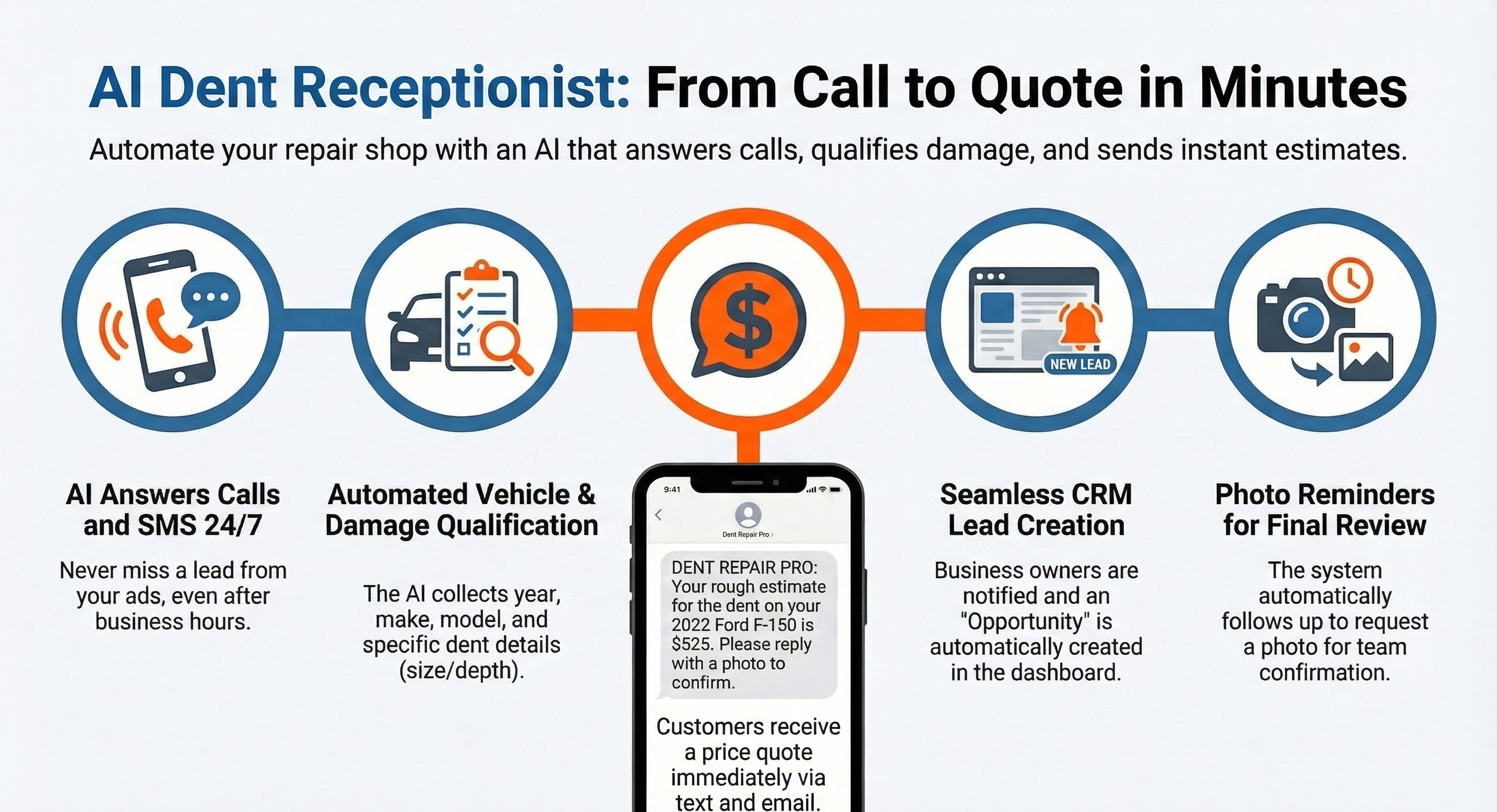
Unlike a traditional answering service that merely records a message, this AI-driven system performs an active intake process. It transforms the “missed call” from a vague notification into a fully qualified file. The system doesn’t just ask for a name; it verifies spelling and gathers high-resolution data points, including the vehicle’s year, make, and model.
This isn’t just data entry it’s a dynamic interaction that handles the messiness of human speech. Consider this exchange from a recent technical demo, where the AI corrects a phonetic misunderstanding in real-time:
AI Receptionist: “Thank you. Just to confirm, your vehicle is a 2015 Teprola. Is that correct?”
Caller: “It’s… Toyota Corolla, 2015 model.”
AI Receptionist: “Thank you for clarifying. So, your vehicle is a 2015 Toyota Corolla, is that correct?”
By the time the shop owner reviews the lead, the AI has already identified the damage location (e.g., driver’s side front door) and confirmed the specific severity of the dent. This removes the “operational overhead” of the initial discovery call, presenting the owner with a lead that is ready for production.
The Expert Logic of the “Instant Quote”
In local services, “speed to lead” is the ultimate competitive advantage. The AI receptionist gains a psychological edge by providing a rough estimate during or immediately following the call, anchored in expert logic rather than guesswork.
The system is programmed to calibrate its pricing based on specific technical variables:
- Location: Single vs. multiple panels.
- Scale: Size measured in inches or compared to balls/coins (e.g., a “six-inch” dent).
- Complexity: Shallow, medium, or deep indentations.
By processing these inputs, the AI can inform the customer: “On the priority detail, your estimate cost is $525.” This immediate transparency shifts the customer’s mindset from price-shopping to logistics. Furthermore, the AI performs a critical industry-specific qualification: it informs the caller that a photo is needed to confirm if Paintless Dent Repair (PDR) is a viable fit, ensuring the shop only takes on the right kind of work.
Closing the Leaky Bucket: Automated Persistence
The conversation doesn’t end when the caller hangs up. The system utilizes an omnichannel approach transitioning seamlessly from Voice to SMS and Email to ensure the lead progresses through the “Golden Window” of conversion.
If a customer promises to send a photo of the damage but gets distracted, the system triggers an automated reminder within 15 minutes. This persistence is vital; it maintains the momentum of the sale while the customer is still in “problem-solving mode.” By working 24/7 across multiple channels, the automation acts as a relentless follow-up specialist, guiding the customer toward the final scheduling link without a second of human intervention.
Collapsing the Administrative Gap
While the customer experiences a high-touch, professional consultation, the “invisible back-office” is busy organizing the business. Every call is logged into a centralized dashboard that provides a bird’s-eye view of the shop’s health.
Key strategic features include:
- Lead Source Tracking: The dashboard identifies exactly which marketing efforts (e.g., specific Google or Facebook ads) are generating the highest-value calls.
- Opportunity Value: Each lead is automatically assigned a dollar value in the CRM such as the $525 estimate allowing the owner to prioritize their morning based on projected revenue.
- Total Transparency: The entire call transcript is recorded and injected into the customer notes, providing the technician with the full context of the damage before they even see the car.
This removes the administrative burden that often plateaus a small business’s growth. The owner is no longer a data entry clerk; they are a decision-maker reviewing a pre-priced pipeline.
A New Standard for “Business as Usual”
The integration of AI voice automation is no longer a luxury for the enterprise; it is a survival tool for the local service professional. By handling top-of-funnel intake and providing frictionless customer experiences, this technology levels the playing field, allowing a solo “Dent Guy” to provide the same responsiveness as a national franchise.
As these digital receptionists become the standard, the bottleneck of the missed call will disappear, replaced by a streamlined, digital-first workflow that captures value while the shop is loud and the owner is busy.
The question for the modern shop owner is no longer if they can afford to automate, but rather: if your business could generate expert quotes and qualify PDR leads while you slept, how much would your “opportunity value” grow by morning?