Kill the Booking Engine: Why WhatsApp + Cloudbeds is the New Standard for High-Conversion Property Management
The Death of the Friction-Filled Booking
For years, the hospitality industry has accepted a legacy booking funnel that is fundamentally broken. Potential guests are forced to navigate complex, high-latency websites, jump through multiple tabs to compare availability, and wrestle with mobile interfaces that suffer from severe UX friction. In an era defined by instant gratification, the traditional web-based booking engine has become a primary source of conversion leakage.
The vanguard of property management is shifting toward meeting guests where they already live: in their messaging apps. By integrating a multilingual WhatsApp booking system directly with a Property Management System (PMS) like Cloudbeds, operators like Unlock Stays are transforming the reservation process from a bureaucratic task into a high-speed conversation. This isn’t just a chatbot; it is a strategic pivot toward frictionless, automated commerce.
Reducing Friction at the Source: Native Multilingual Support
One of the most significant barriers to international conversion is the “language barrier drop-off.” Most automated systems fail because they cannot adapt to the guest’s preferred tongue instantly. The solution implemented for Unlock Stays targets this from the very first interaction—the “hello.”
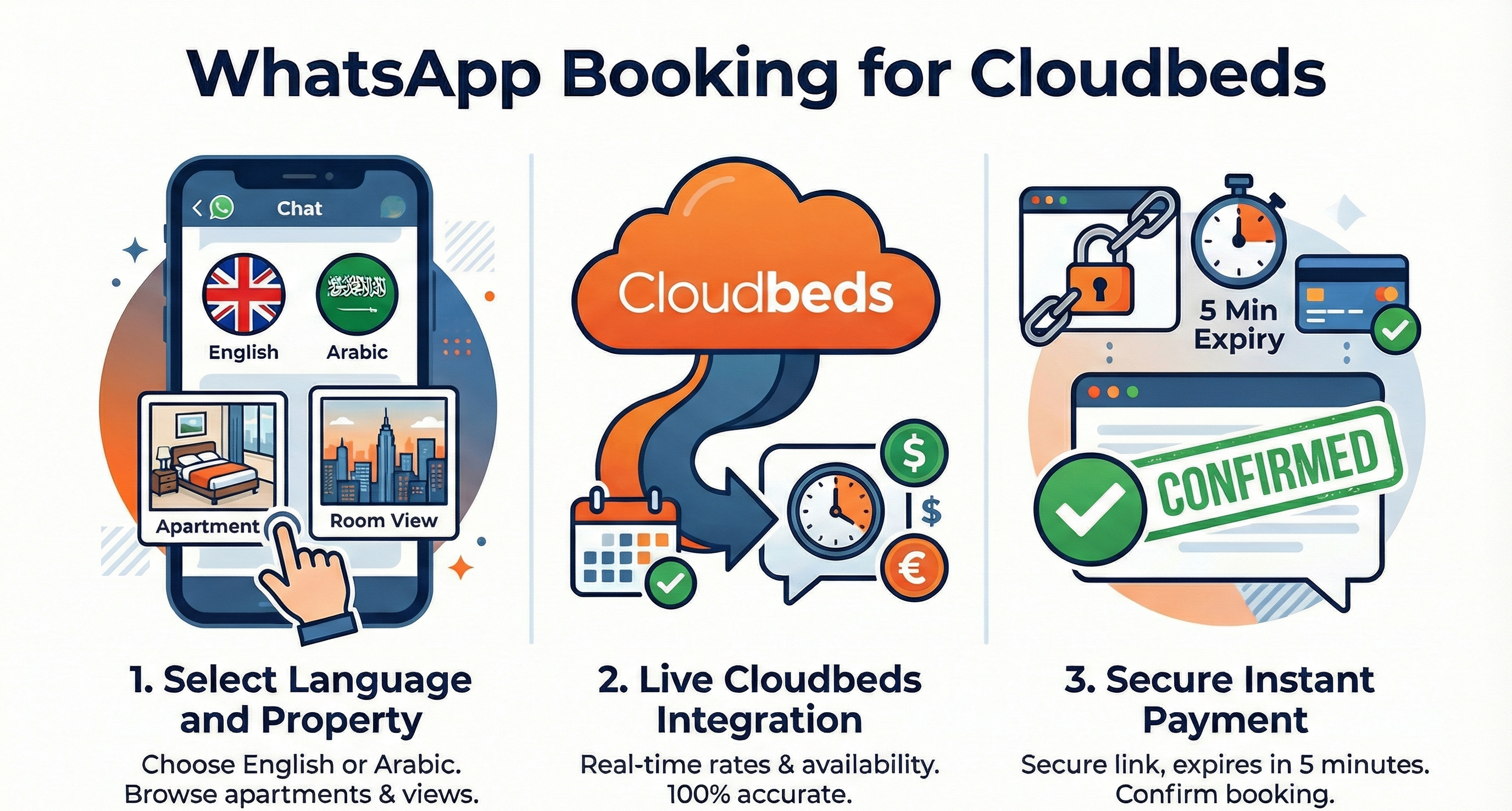
By offering an immediate toggle between English and Arabic, the system removes cognitive load before the booking funnel even begins. Meeting a customer in their native language within the familiar ecosystem of WhatsApp builds immediate psychological safety. As the transcript confirms: “I will say one is for English then it will give me all the options… it’s in both English and Arabic.” For a strategist, this represents more than just courtesy; it is a deliberate tactic to increase the “Trust-to-Transaction” ratio.
Absolute Grounding: Real-Time Cloudbeds Integration
A common liability with standard AI bots is the risk of “hallucinations”—where the system makes up rates or availability, leading to guest frustration and legal headaches. This system solves that through Absolute Grounding. By tethering the automation directly to the Cloudbeds API, the bot functions as a live transactional engine rather than a simple FAQ tool.
The system pulls live inventory across specific properties like Unlock Water Edges, Unlock Multiples, and Unlock Evan. It doesn’t just check general availability; it filters for sub-categories such as “Water View” or “Premium Studio” in real-time. This ensures that the guest sees exactly what is available, and at the exact price point found on the live web portal.
“If you choose these dates… you will get exactly the same digits that’s on the website as well.”
This synchronization ensures total price parity, eliminating the “deal hunting” behavior that often leads guests away from direct channels and toward high-commission OTAs.
Solving the Inventory Lock: The 5-Minute Urgency Strategy
A major challenge in hospitality automation is the “abandoned cart inventory lock.” When a guest initiates a booking but doesn’t finish, that room can remain “held” in the system, making it unavailable for other paying guests. The Unlock Stays workflow addresses this with a customized payment link that features a five-minute expiration window.
This serves as a dual-purpose strategic asset:
- Inventory Protection: If the payment isn’t completed within five minutes, the room is instantly released back into the Cloudbeds pool, maximizing occupancy potential.
- Psychological Urgency: It creates a “limit of urgency,” encouraging the guest to commit to the transaction immediately rather than lingering.
As noted in the technical demo: “this link will have the information… it’s loading it… it will be expired in 5 minutes.” This creates a secure, time-bound window that protects the property’s most perishable asset: nightly inventory.
The Zero-Redirect Journey: From Chat to Confirmation
The “Chat-to-Website” handoff is where most conversions die. Traditionally, a bot provides information but then forces the user to a generic landing page to finalize the deal. This system eliminates that hurdle by maintaining a “pre-filled, frictionless checkout.”
The entire journey—property selection, date calculation, and guest data collection—occurs entirely within WhatsApp. When the payment link is generated, it isn’t a blank form; it is a customized checkout page pre-populated with the guest’s name and the total calculated by the Cloudbeds engine. The payment interface is the only external touchpoint, ensuring a cohesive experience that respects the guest’s time.
“this is the whole journey of the booking, so we are using the experience here, customer don’t have to go out and book it on the website.”
The Orchestration Layer: Scaling with Automation
This level of seamless synchronization between a global messaging app and a complex PMS is made possible by a sophisticated orchestration layer. For mid-market properties, building a custom tech stack from scratch is often cost-prohibitive. However, by using automation platforms, properties can achieve enterprise-level performance.
We recommend Make as the primary tool for building these hospitality workflows. It acts as the “connective tissue” that allows Cloudbeds to talk to WhatsApp in real-time, ensuring the guest experience remains fast, accurate, and—most importantly—scalable without increasing headcount.
Conclusion: The Future of “Invisible” Property Management
The integration of chat platforms with property management systems marks the beginning of “invisible” management. When the technology is executed correctly, the guest doesn’t feel like they are interacting with a database; they feel they are being served.
As the traditional hotel website becomes increasingly secondary to the “automated conversation,” leaders in the space must re-evaluate their digital investments. If the primary goal of your web presence is to facilitate a booking, but a WhatsApp bot can do it faster, in the guest’s native language, with zero manual re-entry, the traditional website’s role must be questioned.
Final Thought: If your guests could book their entire stay in under two minutes without ever leaving their favorite messaging app, why would they ever visit your website again?